


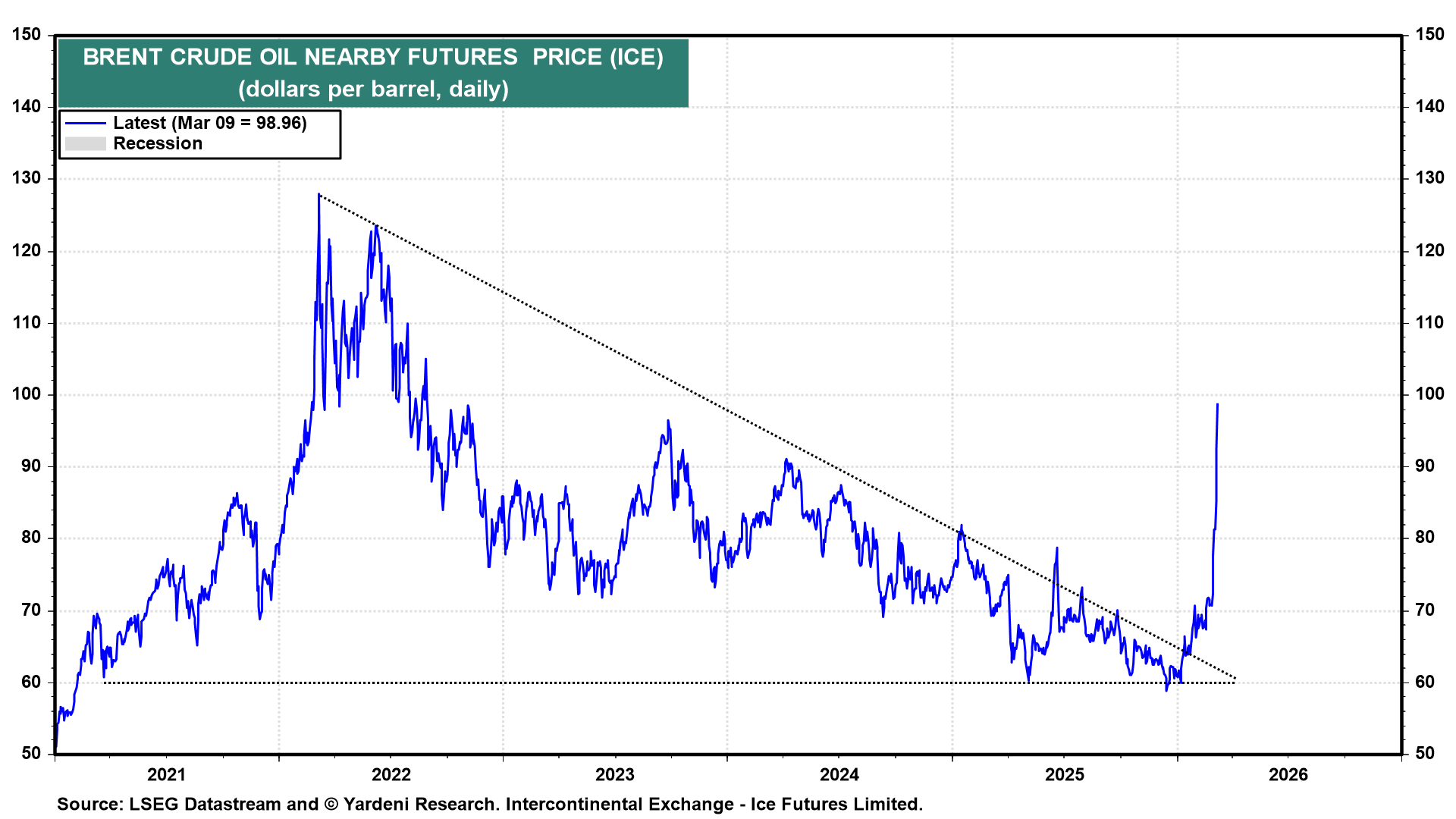
Oftentimes, when the financial markets are hit by bad news, policymakers scramble to calm them. That happened today in response to last night's soaring oil prices (chart).
(1) G7 response. To address the market turmoil following the escalation of the conflict in the Middle East, the G7 Finance Ministers and Central Bank Governors held an emergency virtual meeting today. The group's primary strategy was to signal a "managed urgency" to prevent a sustained global energy shock.
They issued a joint communiqué stating they "stand ready to take necessary measures," specifically mentioning a coordinated release of strategic petroleum reserves (SPR). Reports suggest the group is weighing a release of 300 million to 400 million barrels—a move that would dwarf the 240-million-barrel release following the 2022 invasion of Ukraine. While they haven't pulled the trigger on the release today, the mere official discussion of it has successfully cooled the market. Brent and WTI, which had spiked toward $120 overnight, retreated back toward the $100 mark following the statement. The intraday easing in energy costs helped stocks recover from their worst pre-market levels. This evening, Brent and WTI are back down to about $89. That's an incredible reversal!
(2) Trump bump. President Donald Trump also calmed the financial markets today with assurances that all will be well. He reiterated that the US Navy will soon provide escorts for oil tankers and other commercial vessels moving through the Strait of Hormuz. He again stated the US government would provide political risk insurance and financial guarantees to shipping companies. He described the current gasoline price hikes as a "very small price to pay for U.S.A., and World, Safety and Peace," arguing that prices will "drop rapidly" once the "nuclear threat" is neutralized (chart). The stock market rebounded from its nasty plunge in the morning.
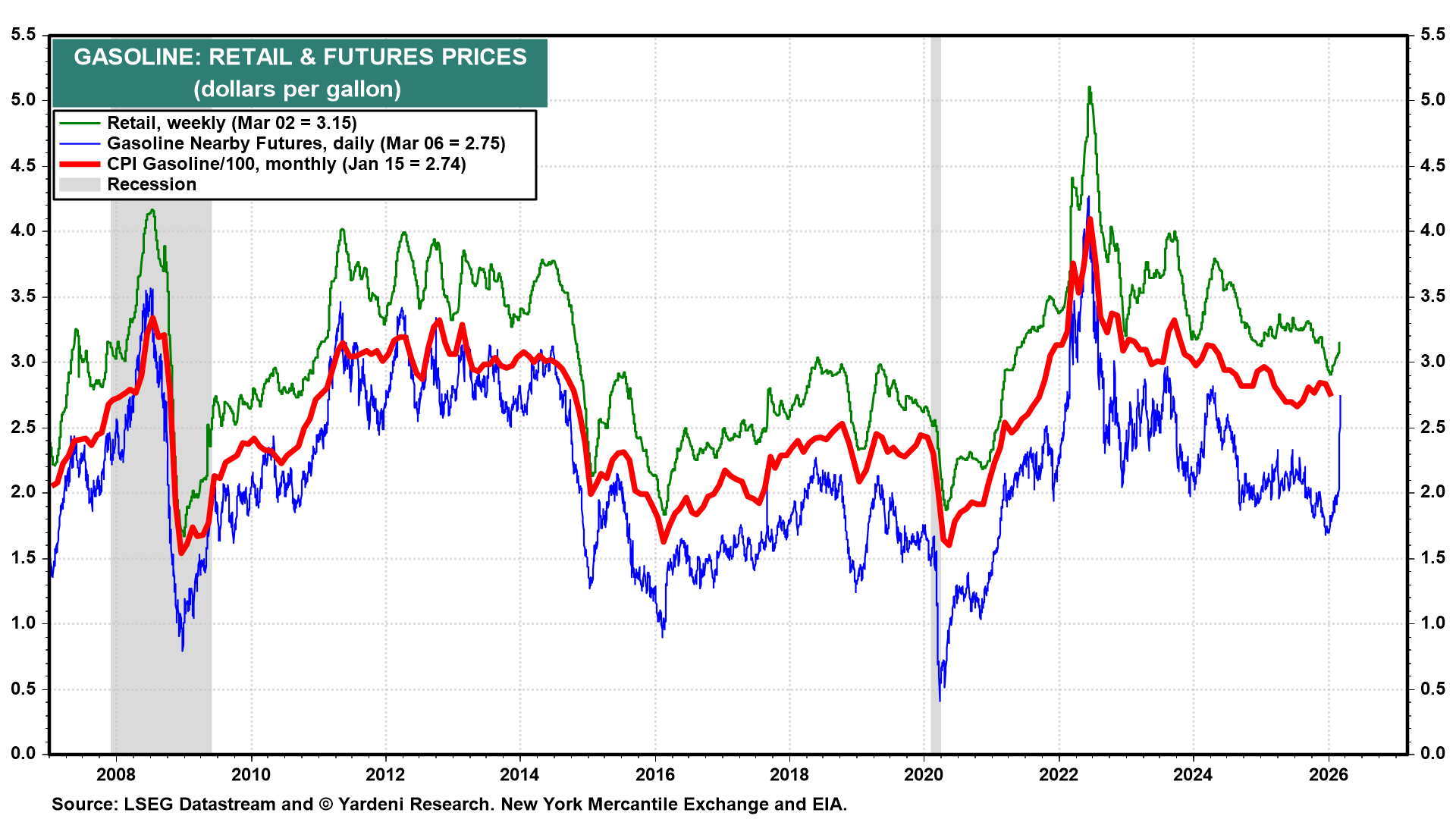
Trump told CBS News that the military operation—Operation Epic Fury—is actually "very far ahead of schedule," hinting that the conflict might be "pretty much complete" much sooner than the initial 4-5 week estimate. After initially downplaying the need for the Strategic Petroleum Reserve (SPR) over the weekend, he signaled today that he is "conscious of prices" and could tap the reserve if necessary.
(3) Mission accomplished? Trump clearly aligns his policy initiatives with the stock and bond markets and acts to mitigate their downsides if initial market reactions are negative. That happened last year when he postponed his Liberation Day tariffs on April 9. The "Trump Put" might be harder to implement in wartime unless he declares victory and lands on one of our aircraft carriers, festooned with a large banner reading "Mission Accomplished." If he does so, what happened to the idea of "unconditional surrender?"
(4) Not so fast. In effect, Trump said that the mission is almost accomplished. Not so fast, according to Secretary of Defense Pete Hegseth. In recent briefings at the Pentagon, he has shifted from his initial "short war" rhetoric. He recently stated that while the US is "winning decisively," the military will take "all the time we need" to ensure success. Specifically, he noted the timeline could stretch to six or eight weeks—nearly double the President's initial 4-week estimate—depending on how quickly they can achieve "uncontested airspace" over Iran.
Secretary of State Marco Rubio has also been more cautious about the "endgame." He recently emphasized that the mission is about "denying Iran the ability to use ballistic missiles," a goal that requires a sustained campaign of "finding, fixing, and finishing" mobile launchers that are difficult to track. He suggested this process would be ongoing rather than a one-time strike.
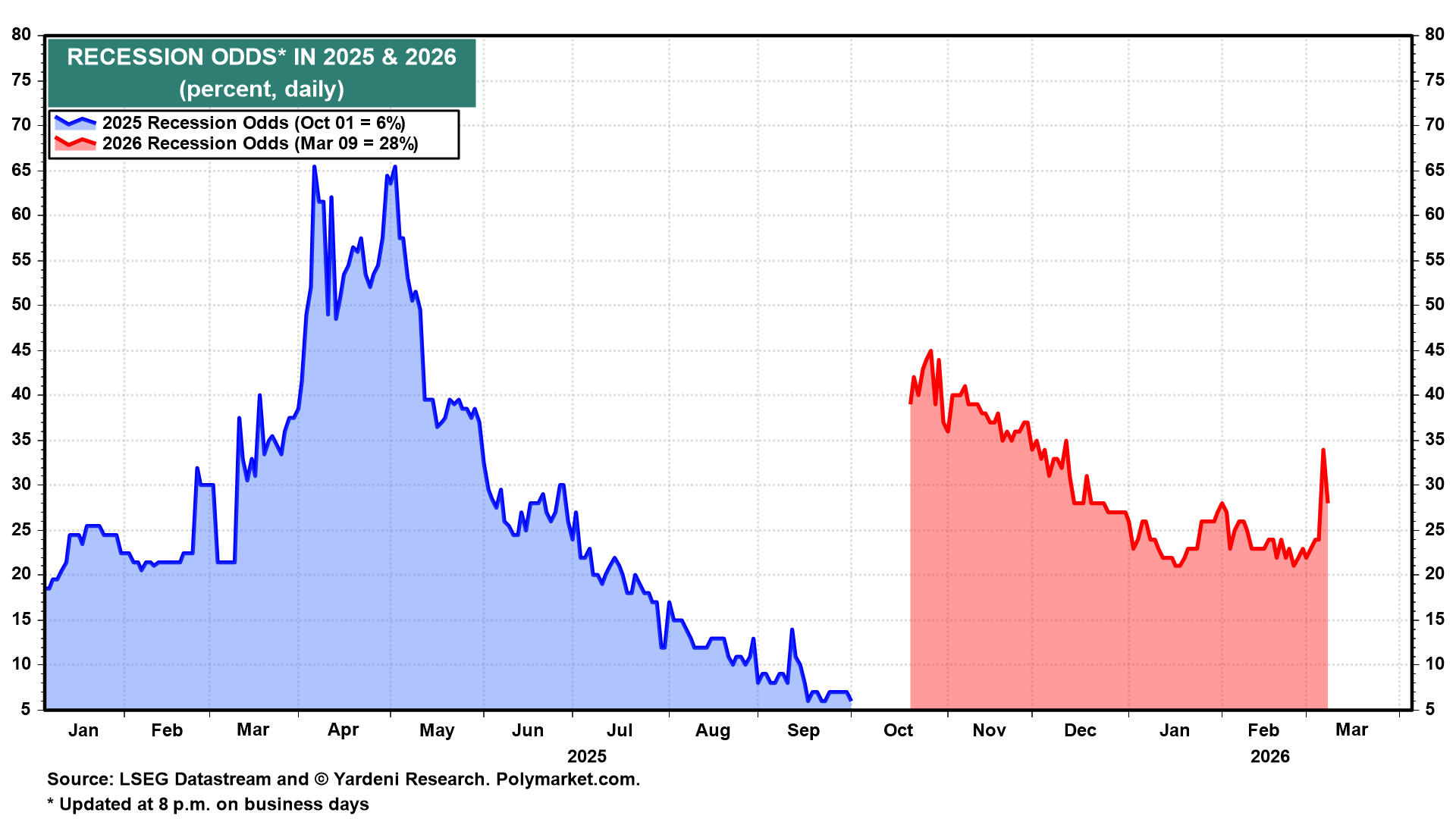
(5) Recession odds. According to Polymarkets.com, the odds of a recession this year jumped to a three-month high of 34% on Friday from 21% on Wednesday, February 25, just before the war started. Thanks to the rapid response by the G7 ministers and the US President, the odds of a recession fell today to 28% (chart).
(6) Feelings. We feel better than we did over the weekend, sort of. We would feel much better (and more bullish) if we saw some ships sail through the Strait of Hormuz without getting attacked by Iranian suicide drones.
