


NEWS FLASH: President Donald Trump postponed Obliteration Day again today, until Monday, April 6 at 8:00 pm EST. He said he is granting a request from the Iranian government to extend the pause on potential airstrikes on Iran's power plants by an additional 10 days. That will prolong uncertainty and volatility in the financial markets.
It also means oil prices will remain elevated for at least another 10 days, unless there is a deal, exacerbating stagflationary pressures worldwide. Today, let's review developments in the Eurozone:
The latest energy crisis is hitting the countries of the European Monetary Union (EMU, or the Eurozone). In 2025, roughly 12% and 8% of the European Union's petroleum and gas imports originated in the Persian Gulf. Unlike the United States, which is an oil and gas exporter, the countries of the EMU are major energy importers. So a spike in energy prices hits the region harder, with higher inflation and weaker growth.
Now, the Eurozone economy is likely to experience a stagflationary bout similar to what happened in 2022 after Russia invaded Ukraine in February of that year, causing energy prices to soar back then too.
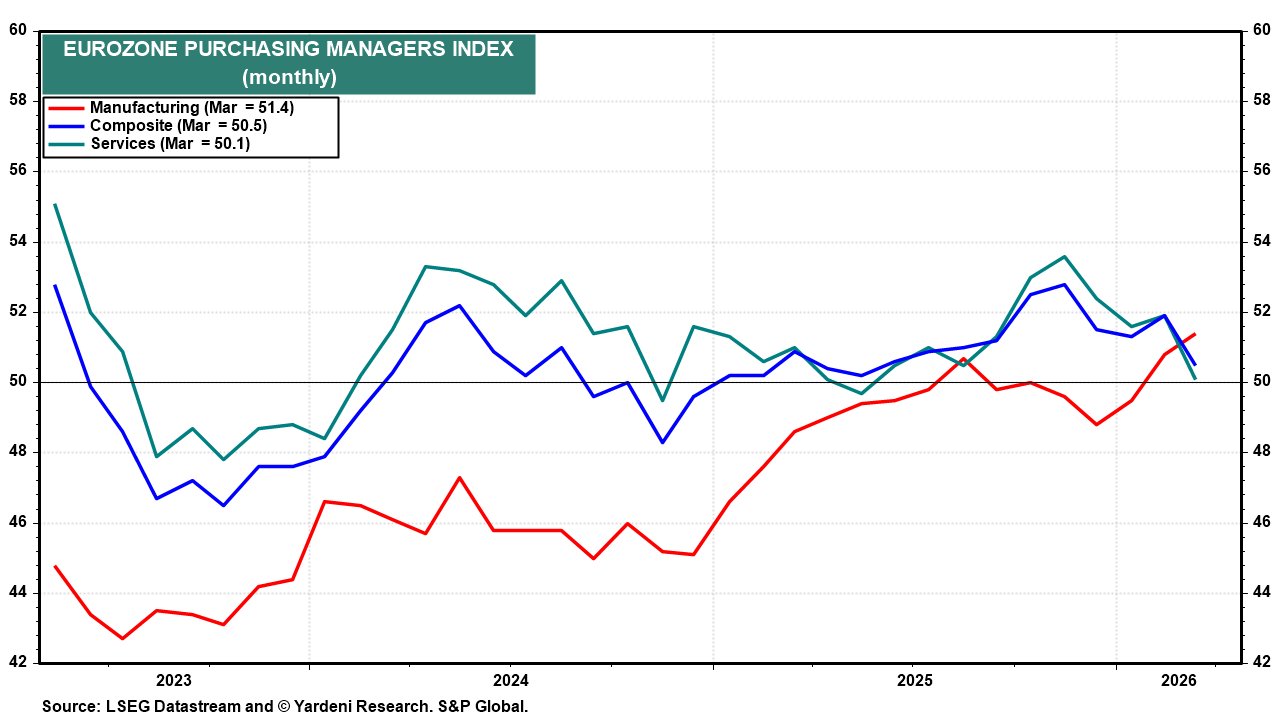
Before the war, which began at the end of February, the Composite PMI was 51.9 (chart). It fell to 50.5 in March, according to S&P Global. The Services PMI accounted for the decline, while the Manufacturing PMI continued to rise. Supply delays were reported by manufacturers more widely than at any time since October 2022. Average input costs rose at the fastest rate for 10 months. Higher costs were passed on to customers, resulting in the largest rise in selling prices in over three and a half years.
Eurozone consumer confidence dropped sharply in March (chart). An index of German consumer sentiment fell to its lowest in two years this month, and similar surveys in France and Italy also show growing unease. At the petrol stations, where the oil shock is felt most immediately by consumers, the cost of a 50-litre tank of diesel in Germany has risen by over €21 compared to the week before the war.
