


I. Bonds
On Wednesday, the Treasury Department announced that it was doubling the size of its effort to buy back Treasury securities with maturities between 10 and 30 years, to $4 billion per operation. Long-dated Treasury borrowing costs had been rising sharply amid competition for capital from AI data-center builders, and on worries about government deficits. US sovereign debt hit a record $40 trillion on Wednesday.
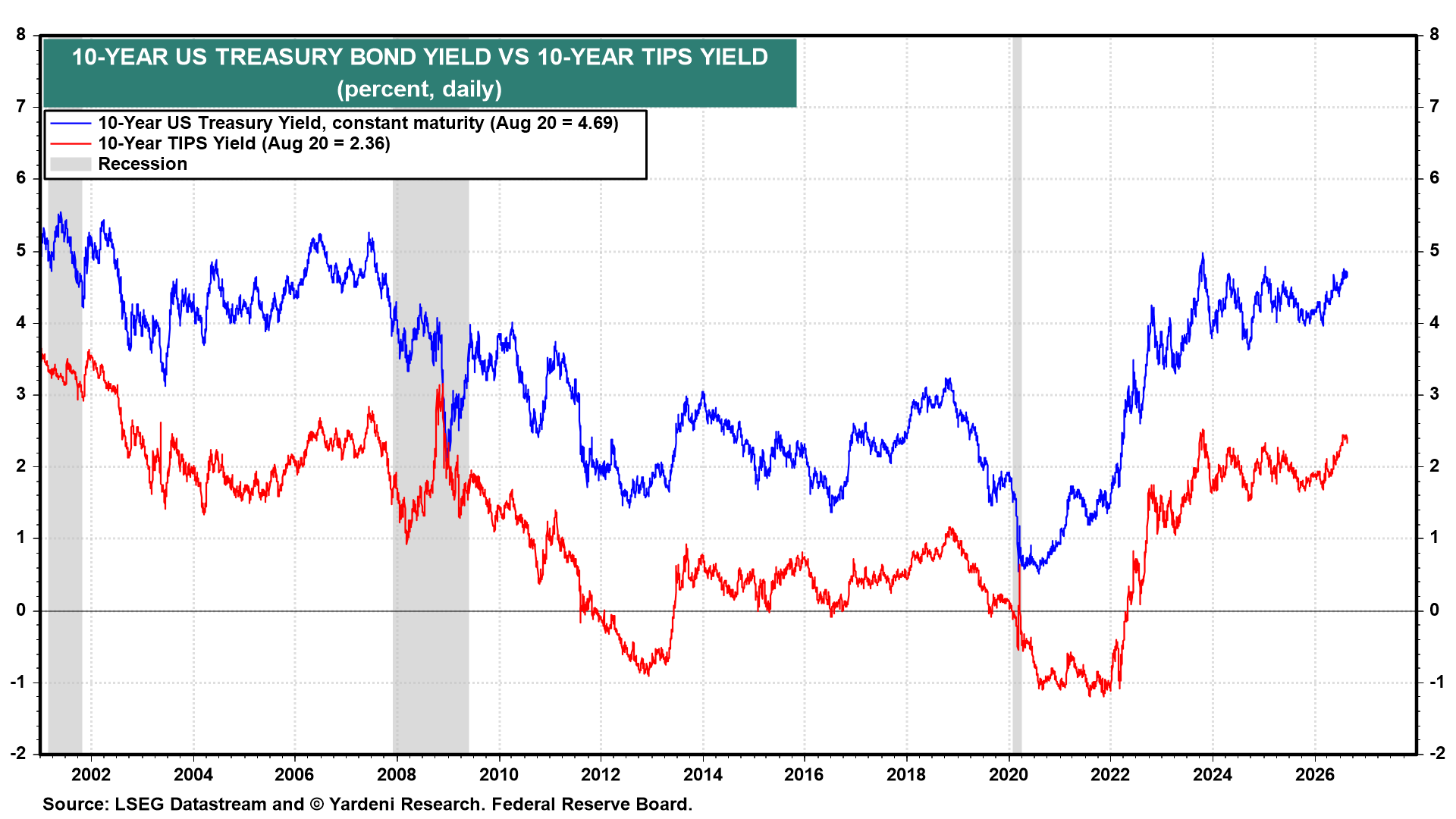
Bond yields fell slightly on yesterday's news. Today, they edged back up (chart). So, has Treasury Secretary Scott Bessent's attempt to stabilize the bond market already failed? Does this mean that a government debt crisis is imminent? That seems to be the reaction of a few commentators, especially those who have been predicting such a crisis for many years.
As we noted yesterday, Treasury buybacks are structured to repurchase older, less liquid ("off-the-run") government bonds from primary dealers, freeing up dealer balance sheets and improving secondary market functioning. Bessent isn't trying to lower bond yields. Rather, he is trying to stabilize them so Treasury auctions go smoothly, particularly yesterday's 20-year auction.
So we are sticking with our base-case scenario for the bond market. We expect that the 10-year Treasury yield will remain in a 4.00%-5.00% range through the end of this year and next year.
Our relatively constructive view reflects that Bessent's Treasury is following former Treasury Secretary Janet Yellen's 2023 playbook by financing more of the deficit in the Treasury bill market (chart). In effect, the Treasury is forcing the Fed to buy Treasury bills to keep the federal funds rate from rising.
