


The people who've created large language models (LLMs) to power artificial intelligence (AI) are now using them to code better LLMs. If LLMs are now so good at coding that they can create their own better versions, who needs coders anymore? Are the only jobs left in the software industry the ones for LLM prompters? In 5-10 short prompts, they have to tell the LLM what new software agent to create. How long will it take for LLMs to learn to prompt themselves?
We still believe that AI is artificial but not intelligent. The output of LLMs sounds intelligent, but these models don't have a clue about what words actually mean. Nevertheless, so far this year, the stock market has been discounting a scenario in which AI is our Frankenstein monster. We created it, and it will soon turn on us humans.
The first victims will be white-collar workers in every industry. The calamity may already have begun in the industry that created the monster, i.e., information technology. Payroll employment has been flat there since late 2022, when ChatGPT was first released (chart).
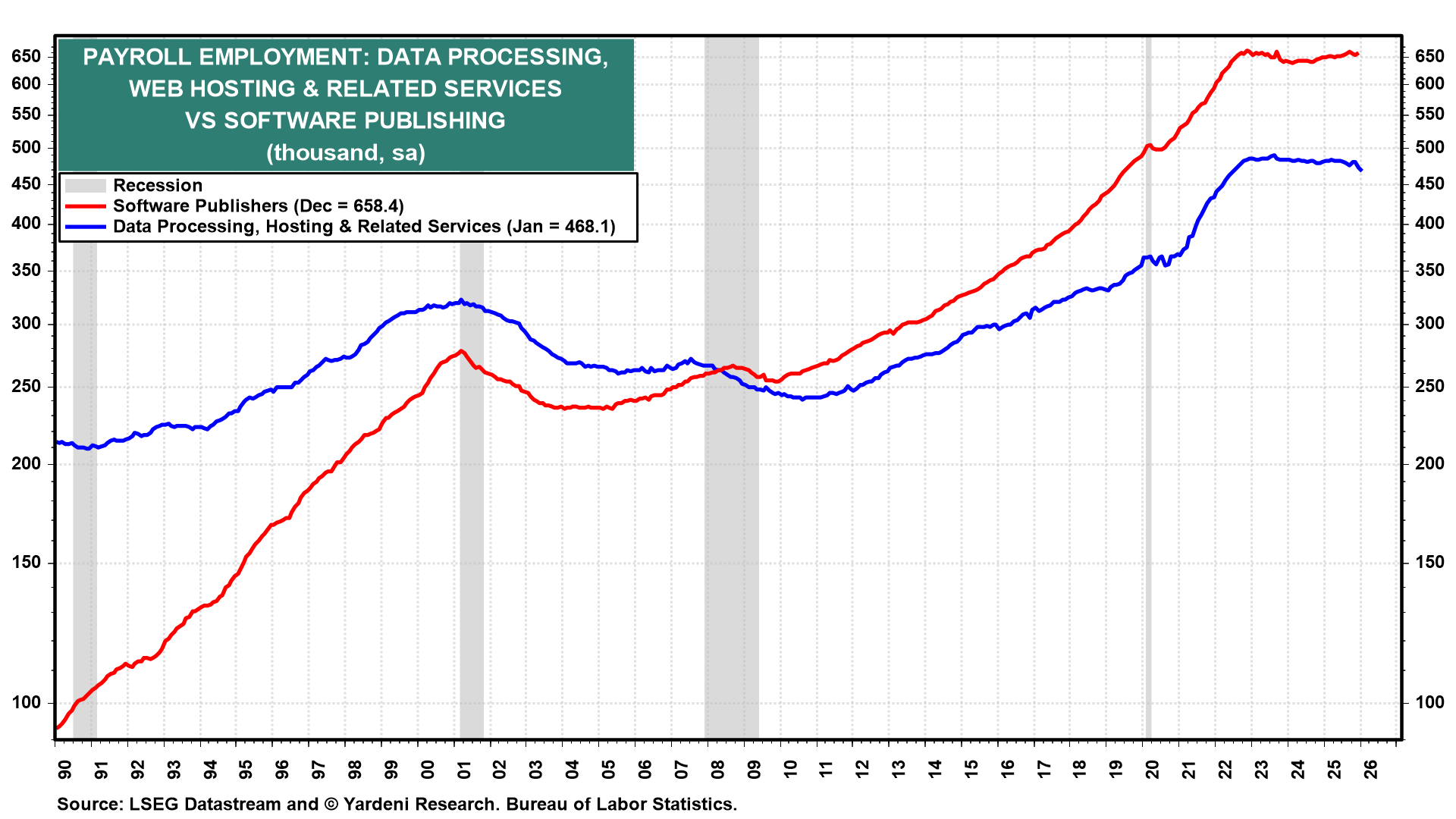
If white-collar workers lose their jobs and are forced to take lower-paying positions, consumer spending will be hard hit, weakening blue-collar jobs as well. Apparently, this nightmarish scenario depressed stock prices today with the release of a Citrini Research report titled "The 2028 Global Intelligence Crisis." Josh Brown posted it on social media today. Also depressing the market was a sharp drop in IBM's stock price after it was reported that Anthropic may have an agent that challenges IBM's COBOL software.
The good news is that bullish sentiment must be dropping rapidly, as the AI story has morphed from a Roaring 2020s productivity booster to an existential threat to our way of life. We continue to believe that AI is augmenting workers' productivity rather than making them extinct.
After the stock market closes on Wednesday, we expect Nvidia's CEO, Jensen Huang, to provide a much more upbeat view of AI's impact on our future during the company's conference call.
Meanwhile, the rotation we predicted on December 7, 2025 continues, from the Magnificent-7 to the rest of the market—i.e., the Impressive-493 and the S&P 600 SmallCaps and S&P 400 MidCaps. So does the rotation from the US to the rest of the world. All the AI commotion and the latest chapter in Trump's Tariff Turmoil are driving the price of gold closer to our year-end targets of $6,000 per ounce by the end of this year and $10,000 by the end of 2029:
