


I. The New Treasury-Fed Accord
In November 2025, Treasury Secretary Scott Bessent said, "My job is to be the nation's top bond salesman. And Treasury yields are a strong barometer for measuring success in this endeavor." Recently, however, the Bond Vigilantes are demanding lower prices (higher yields) for what Bessent is selling. The 10-year Treasury yield reached its highest level of the year, while the 30-year climbed to its highest level since 2007 (chart).
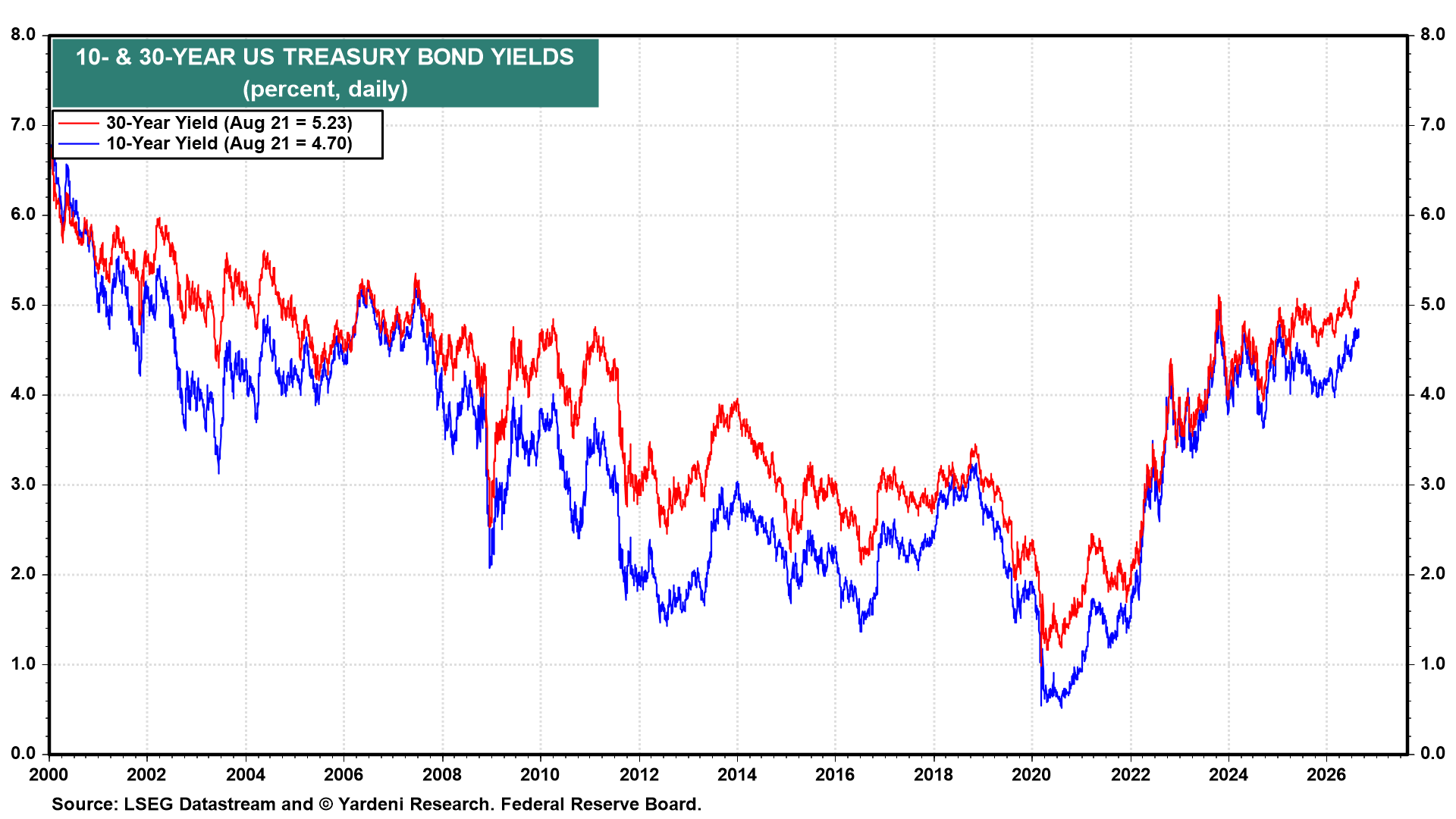
That has prompted Bessent to make three sales pitches to the Bond Vigilantes recently:
Pitch I came when the Treasury joined Japan in a rare intervention to support the yen after it fell to multi-decade lows, reducing the risk that Tokyo would have to sell its US Treasury securities to prop up its currency. That support actually unnerved bond investors by reminding them that the US depends heavily on the kindness of strangers.
Pitch II came last Wednesday, when the Treasury doubled buybacks of 10- to 30-year securities to $4 billion per operation. During Janet Yellen's term as US Treasury Secretary, the buyback program was designed to support secondary market liquidity by regularly buying back less liquid, "off-the-run" nominal coupons and TIPS.
Pitch III came today, when CNBC reported that the Treasury could use its nearly $1 trillion Treasury General Account (TGA) to help fund expanded long-bond purchases. TGA is the Treasury's checking account at the Fed.
This may be the start of the Treasury's own version of Operation Twist. In the original Operation Twist, the Fed sought to lower long-term interest rates by selling short-term Treasuries and buying long-term ones. The strategy was first used in 1961 with modest success and revived in 2011, when it is estimated to have lowered 10-year Treasury yields by 15-25 basis points.
