I. Curbing Our Enthusiasm
Last week on Tuesday, we pushed our 8,400 year-end target for the S&P 500 to mid-2027. Our new year-end target is 7,900. We remain confident in the resilience of both the economy and S&P 500 companies’ earnings per share (EPS). On the other hand, we think recent developments may weigh on their stocks’ valuation multiples for the rest of the year.
The recent re-escalation of the war in the Middle East increases the chances of higher-for-longer oil prices and stickier inflation. As a result, the FOMC voted unanimously to hike the federal funds rate (FFR) last week, and the Committee seems set to tighten some more in the coming months. Bond yields remain on an uptrend worldwide. A growing backlash against the proliferation of AI is also weighing on valuation multiples. It is becoming a political issue during midterm congressional campaigns, and the election results are likely to exacerbate the partisan divide in the US.
Then again, perhaps President Donald Trump will soon find a way to end the war, causing oil prices to drop. Perhaps China will convince Iran's IRGC to stop their Houthi friends in Yemen from disrupting shipping through the Red Sea. Perhaps bond yields will stop rising. Perhaps.
In any event, our base-case scenario remains a continuation of our Roaring 2020s scenario, which has been underway for almost seven years. It posits that rapid, noninflationary economic growth will result from tech-led productivity growth. We give it 70% odds of continuing. So far, so good: Three more years to go. Nevertheless, we'll keep updating our worry list of unhappy scenarios, which currently has a subjective probability of 30%.
For now, let's review the recent developments in the financial markets.
II. Earnings Exuberance
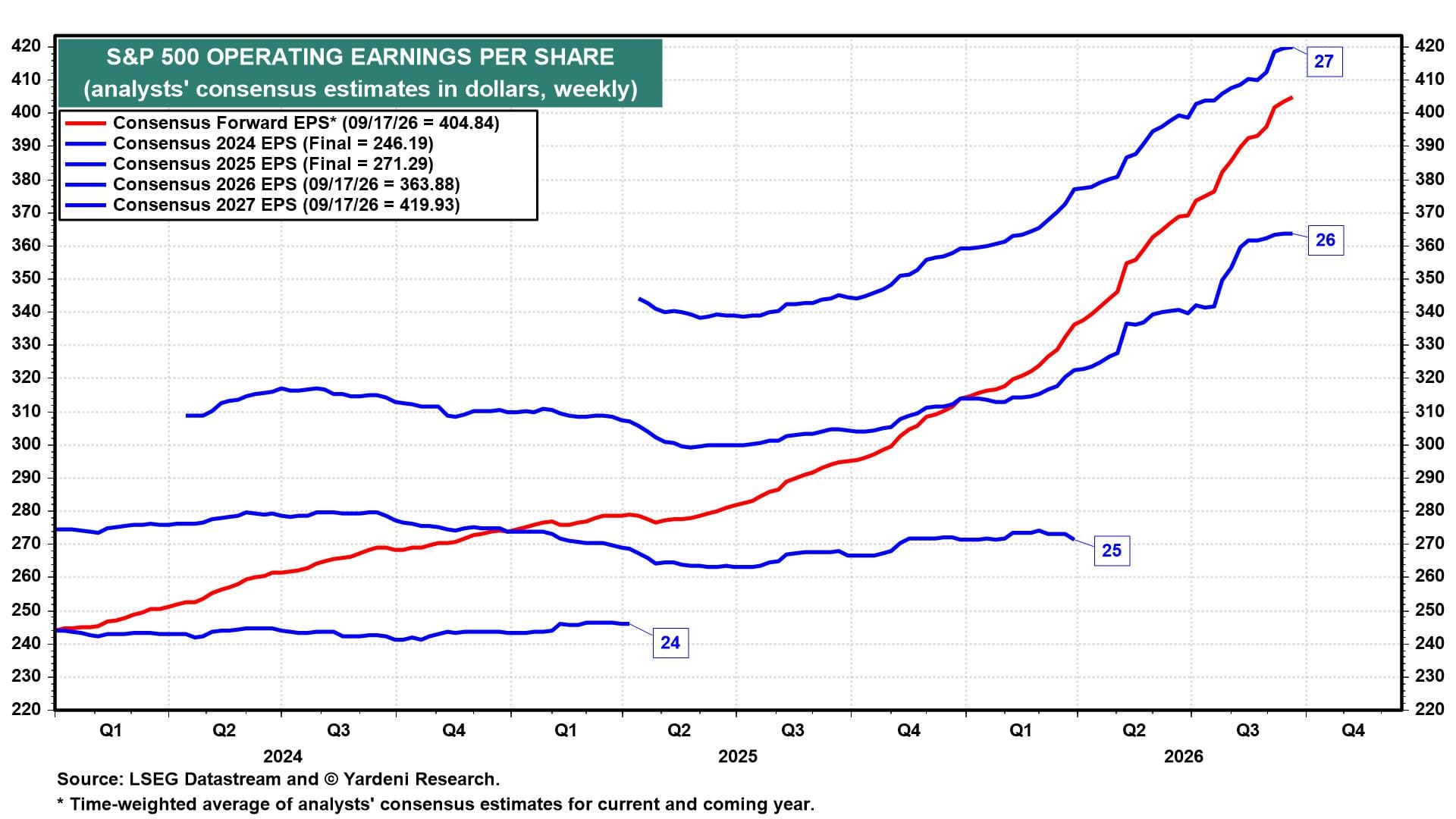
S&P 500 companies’ forward EPS rose to a record $404.84 last week (chart). The analysts' consensus 2027 EPS estimate is up to $419.93. We expect it to keep climbing to $425 by year-end, which would put forward EPS at $425 too.
Multiplying that forward EPS target by a forward P/E of 18.6 yields our year-end target of 7,900. To get to 8,400 by year-end, the forward P/E would have to rise to 19.8. The current forward P/E is 18.9.
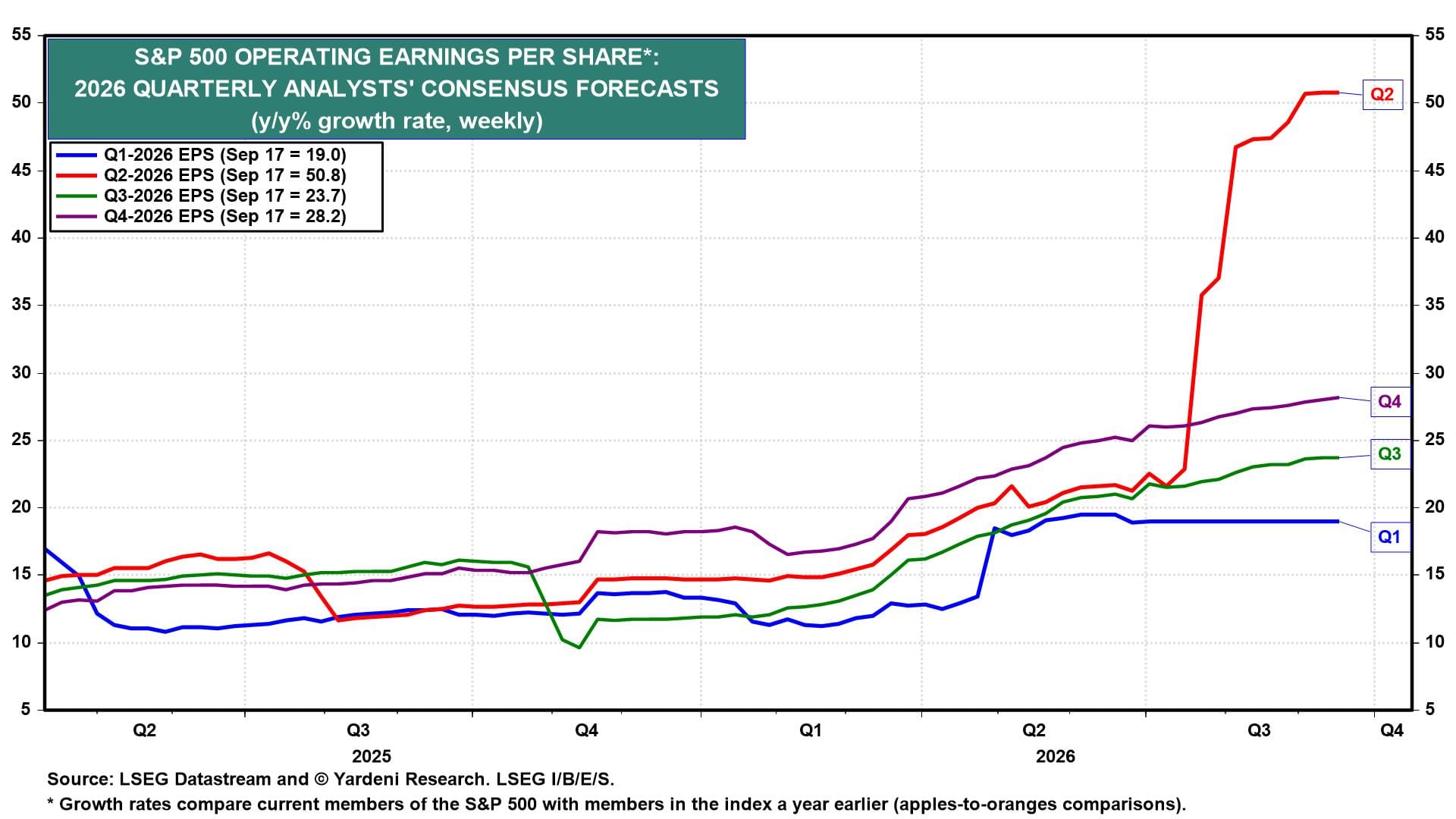
The Q3-2026 earnings season starts in early October. Analysts project 23.7% y/y growth for Q3 and 28.2% for Q4 (chart). Both estimates continue to rise. Q2's 50.8% jump included huge mark-to-market capital gains; excluding those gains, EPS growth was about half that. Analysts’ estimates for the second half of the year carry no such distortion.
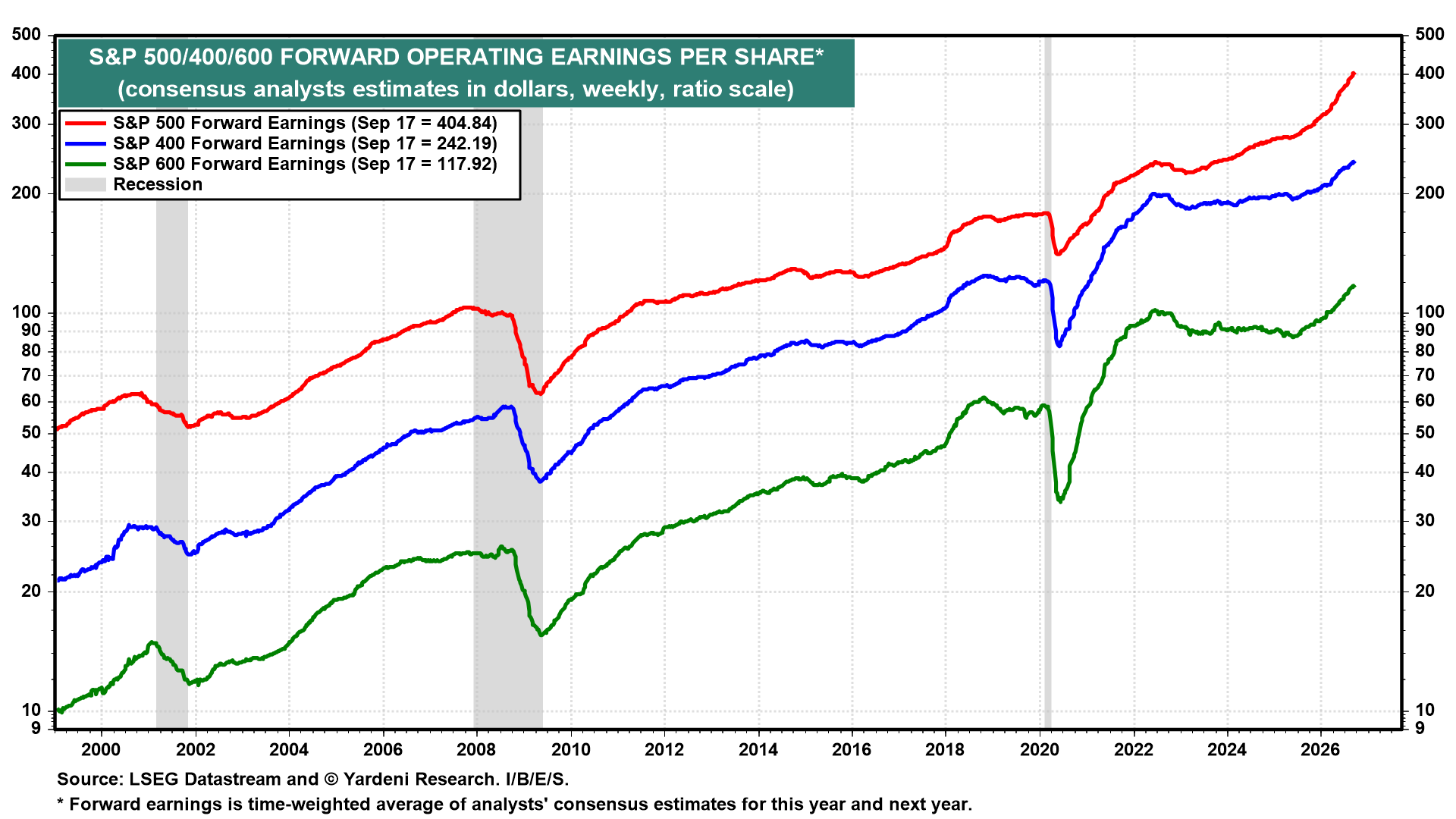
Forward earnings rose to record highs for the S&P 500, S&P 400, and S&P 600 last week (chart). Fabulous earnings momentum (FEMO) isn't just a LargeCap story.
III. Valuation Compression
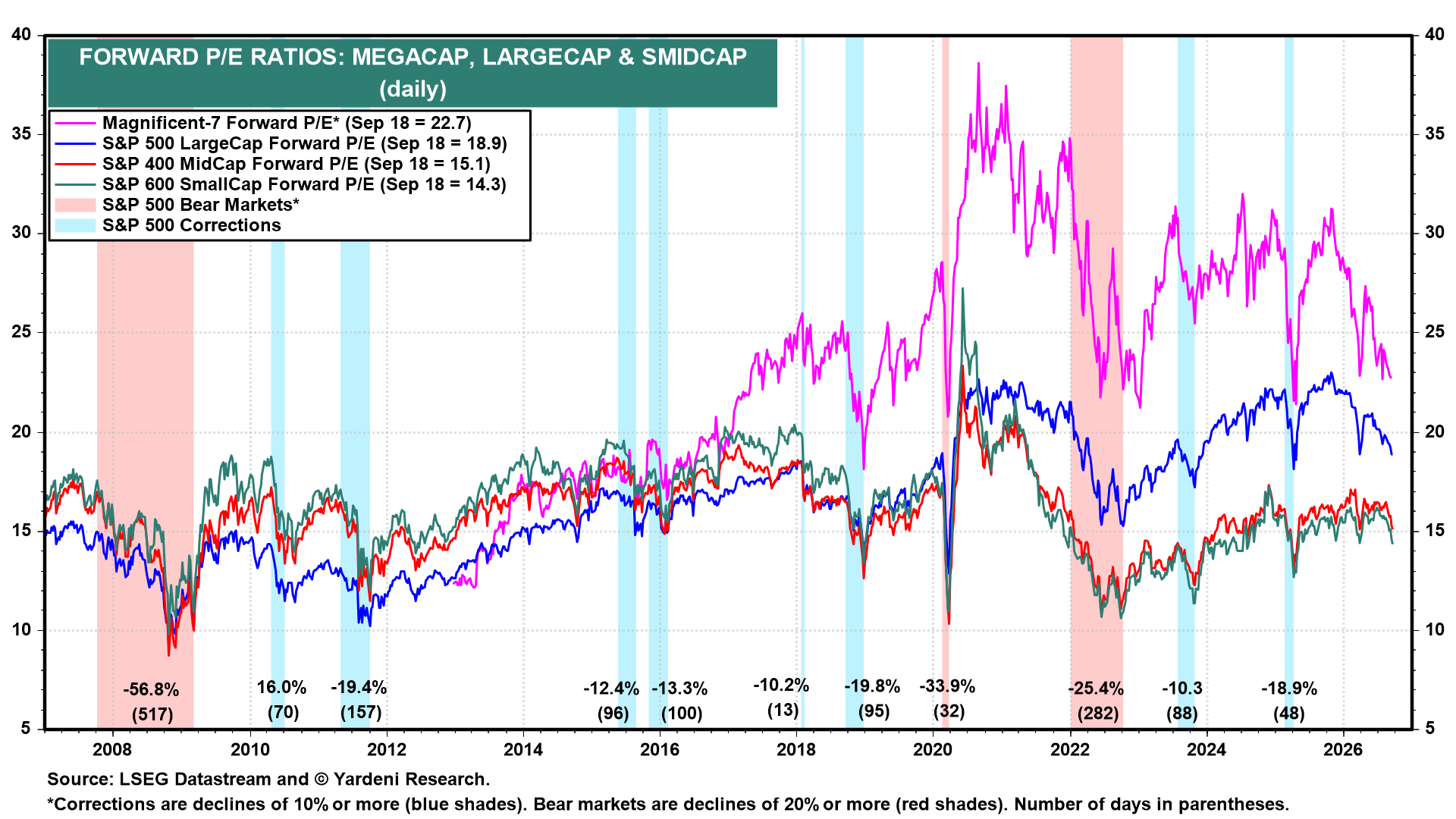
The S&P 500’s forward P/E is down to 18.9, with the Magnificent-7’s at 22.7, the S&P 400’s at 15.1, and the S&P 600’s at 14.3 (chart). As earnings have soared this year, forward P/Es have declined. FEMO has been partly offset by less FOMO (fear of missing out). While analysts have been increasingly exuberant about earnings, investors have been curbing their exuberance.
Investors want a valuation discount for the known unknowns: How far will the Fed tighten from here? How long will the war last? How high will oil prices and bond yields go? What will the midterm elections deliver? Will the AI labs' push to slow frontier development slow the capital-spending boom driving earnings? By how much?
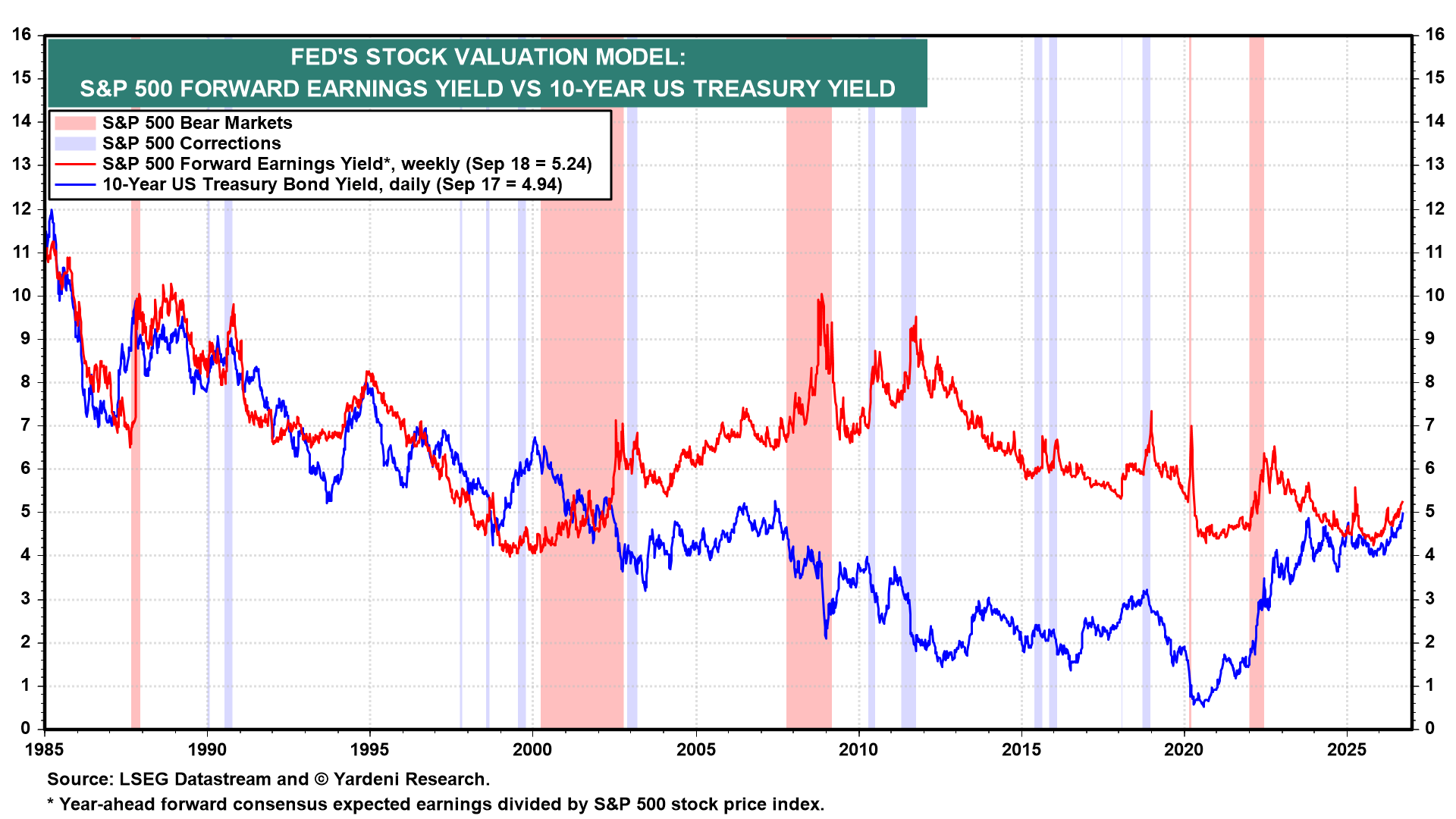
The Fed's Stock Valuation Model (named as such by Dr. Ed in 1997) is working again (chart). The S&P 500 earnings yield and the 10-year Treasury bond yield are moving in tandem. Rising bond yields are depressing the forward P/E, which is the reciprocal of the forward earnings yield.
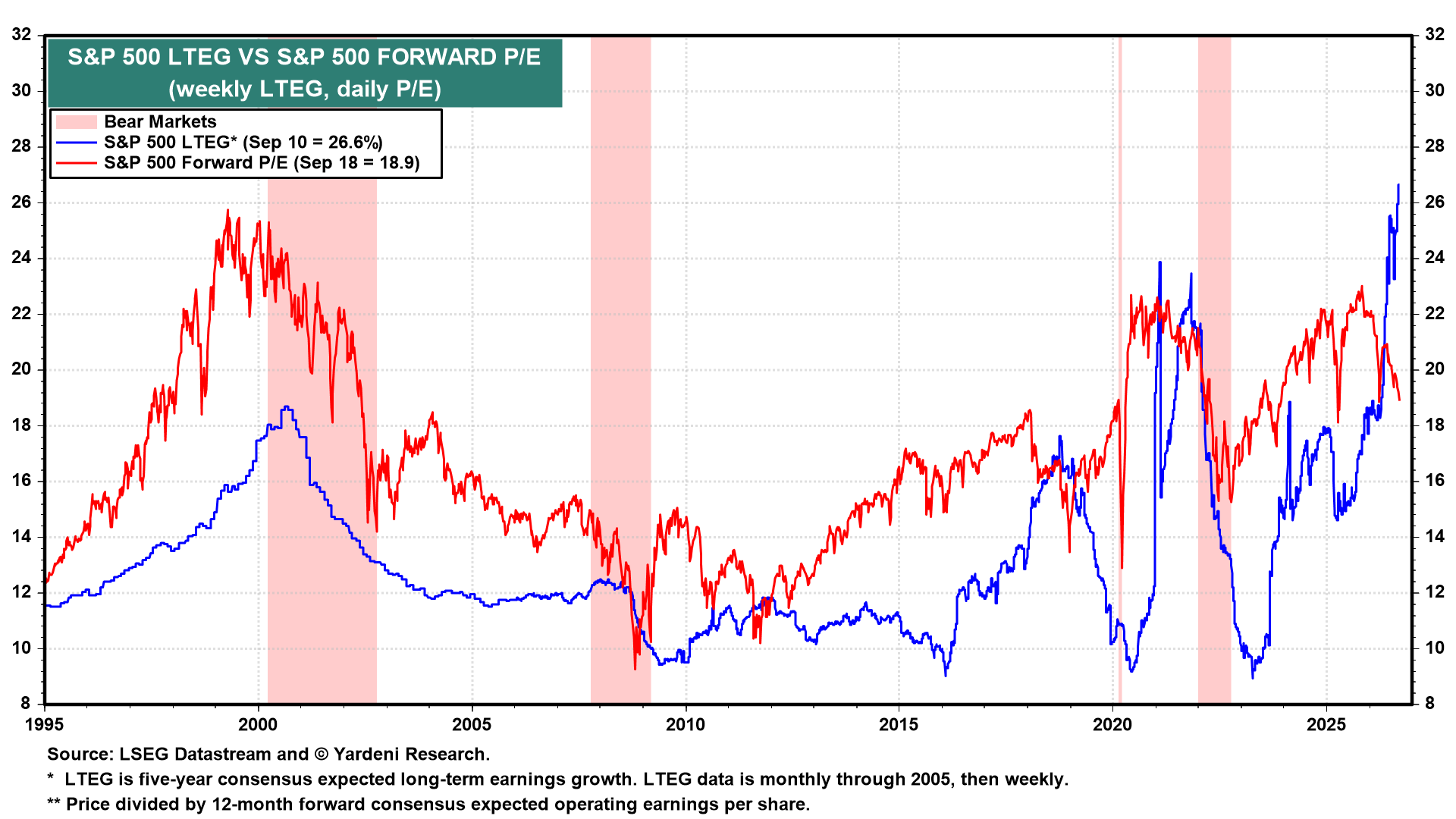
Analysts' consensus long-term annual earnings growth (LTEG) expectation is up to 26.6%, as analysts have kept raising what they think their companies will earn over the next five years. That’s well above the 18.9 to which the S&P 500 forward P/E has fallen (chart). During the 1999 Tech Bubble, both LTEG and the forward P/E moved higher together and then fell together during the Tech Wreck. Their disconnect now shows that investors aren’t completely buying what analysts are selling.
IV. Investor Sentiment Mixed
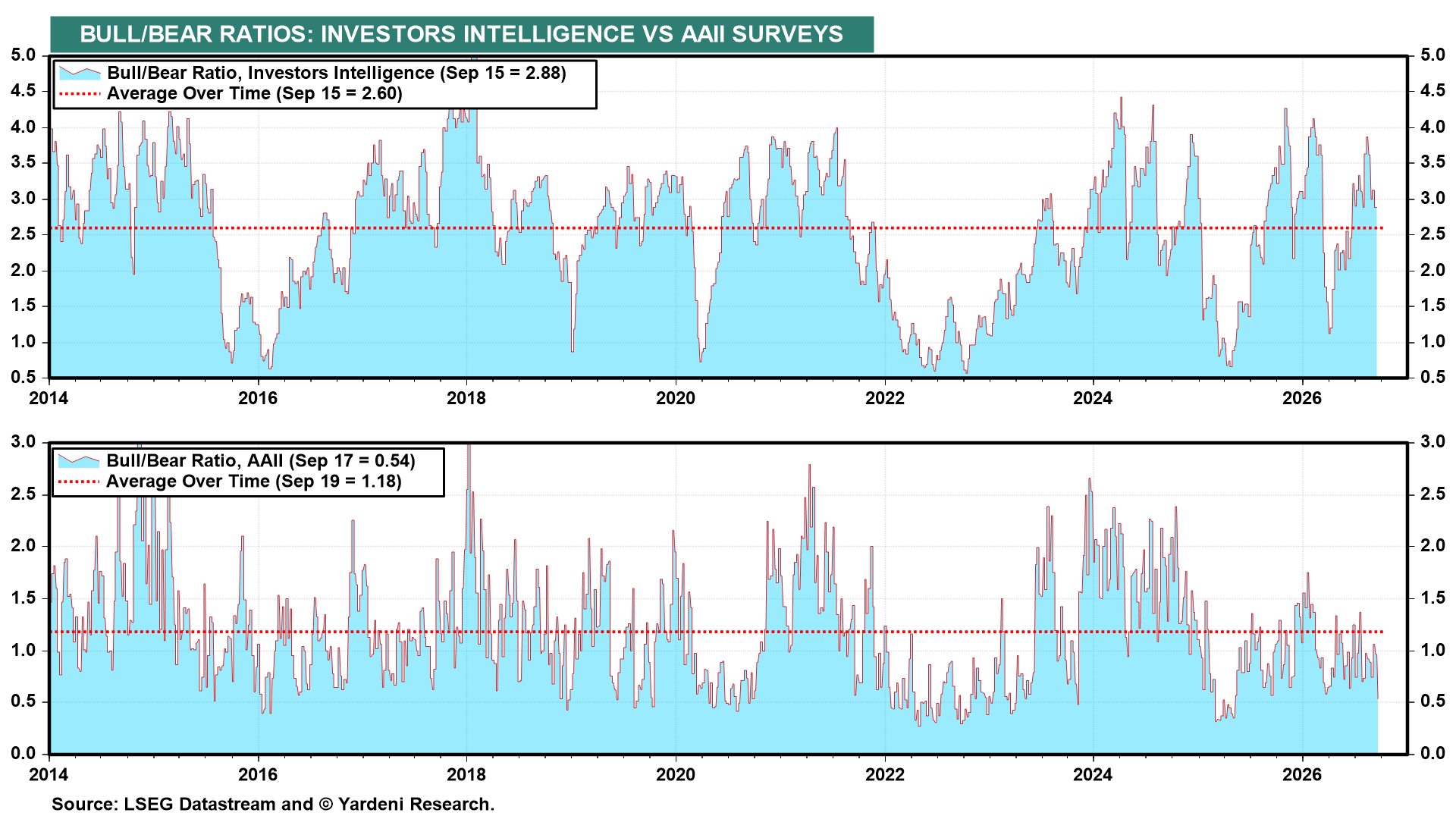
The Investors Intelligence Bull/Bear Ratio eased to 2.88 last week, close to its 2.60 average, while the AAII ratio fell to 0.54, well below its 1.18 average (chart). Institutional bullishness has come off its summer extreme, and retail remains washed out, which is constructive on a contrarian read.
V. Bond Yields On 5% Fence
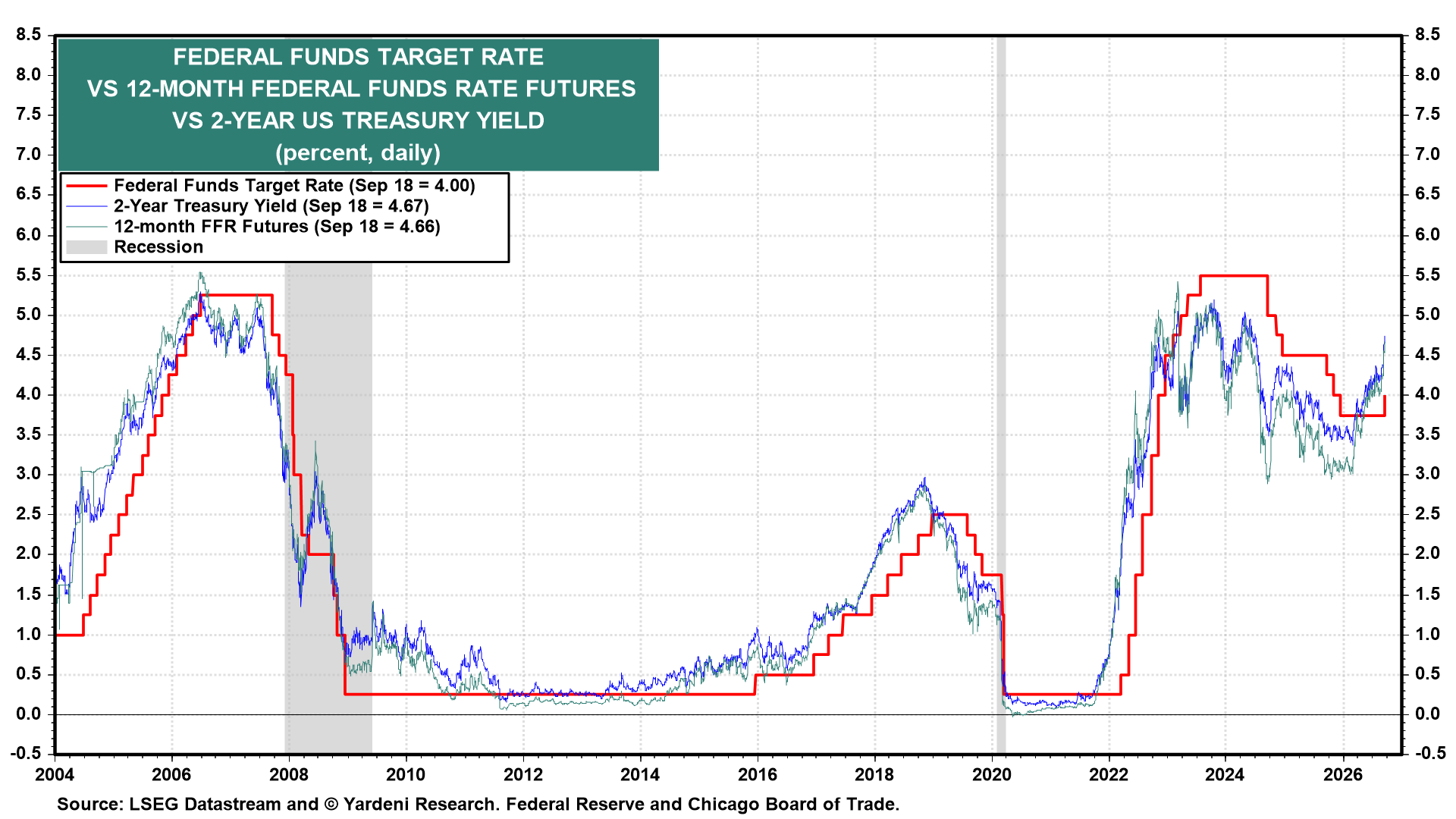
Following Wednesday's FOMC decision, the 2-year Treasury yield is at 4.67% and 12-month FFR futures is at 4.66% (chart). They both imply roughly two and a half more 25bps FFR hikes over the coming year.
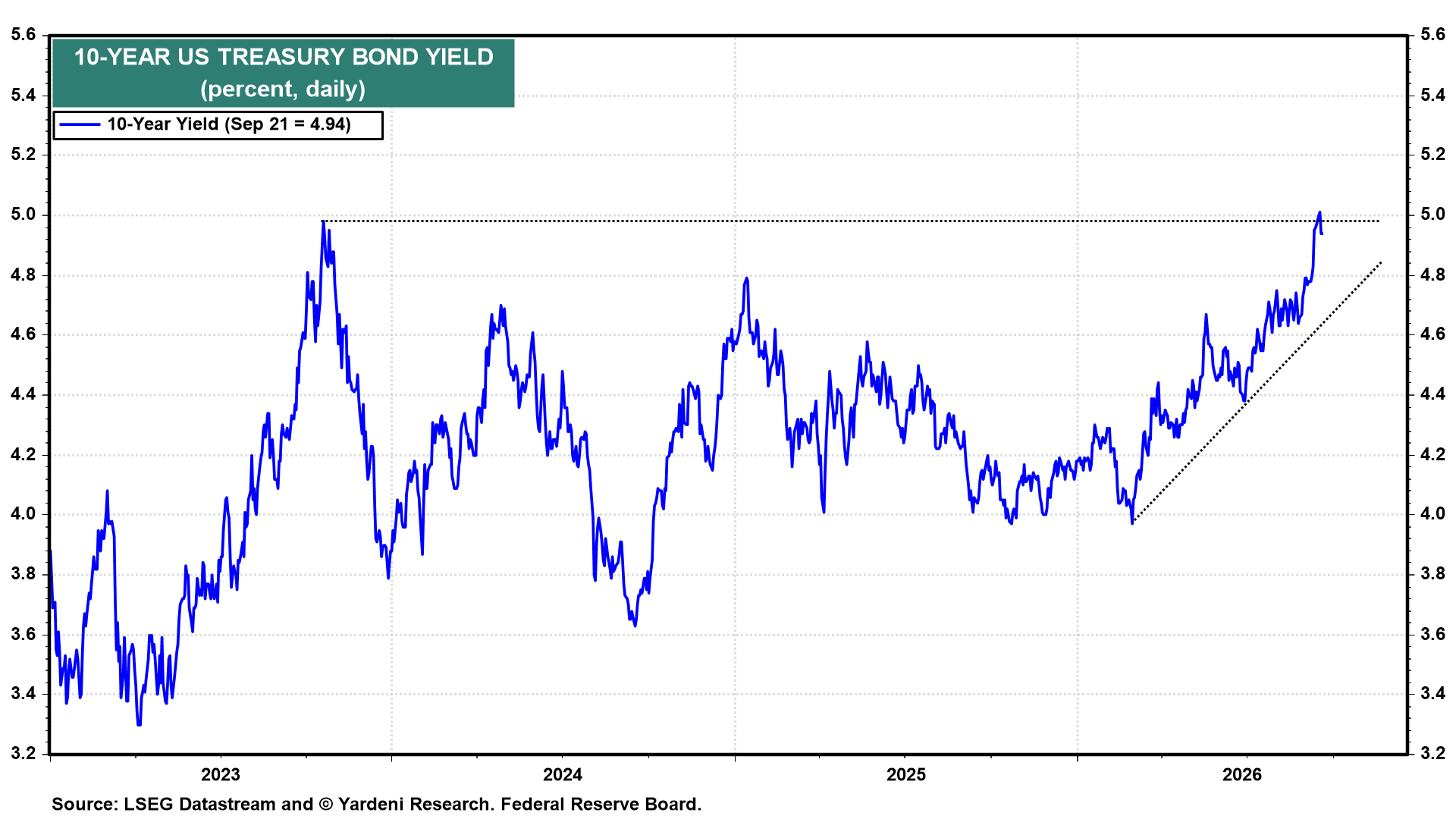
The 10-year Treasury yield is at 5.00%, the top of the 4.00%-5.00% "old normal" range that we have argued is the right one for this business cycle (chart). A sustained Fed tightening cycle could push yields into abnormal territory.
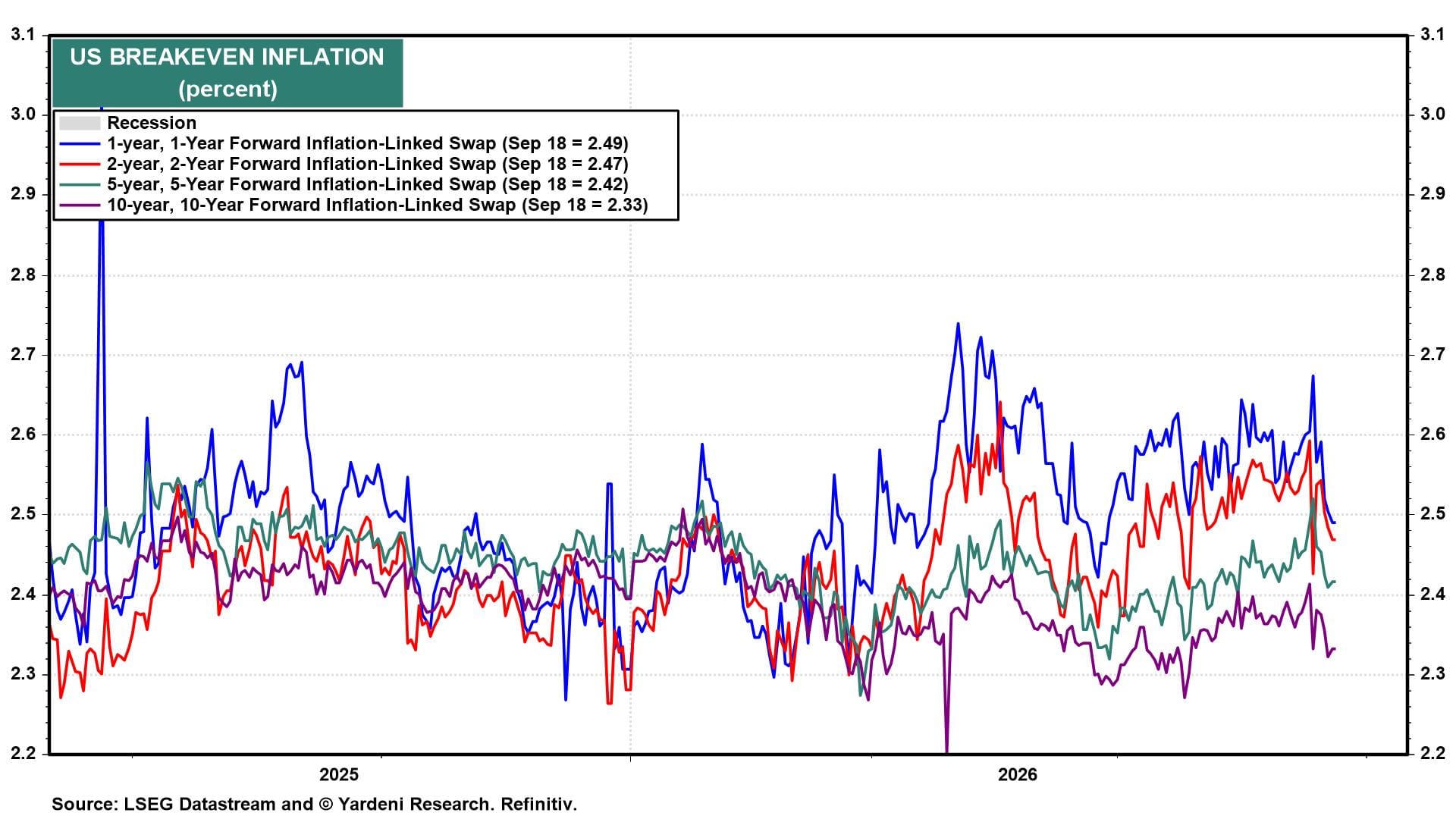
The good news is that breakeven inflation rates dropped sharply after the Fed raised the FFR on Wednesday (chart).